Understanding AI Agents: An Overview
How AI Agents Are Transforming Work and Life
I'm a solutions engineer lead, GitHub Star, Director of WomenDevsSG, and co founder of ragTech. I work at the intersection of tech, systems, and leadership, and this blog is where I share my journey through all three. Expect honest reflections, real experiences, and thoughts that are still forming rather than polished career advice.
Artificial Intelligence (AI) has taken a central role in transforming how we interact with technology, from virtual assistants like Siri and Alexa to complex problem-solving systems. Among these advancements, AI Agents are rapidly becoming a critical tool for businesses and individuals alike.
But what exactly are AI Agents, and why should you care about them?
Let’s break it down, using practical examples to illustrate their power and potential.
Example
Let’s say I login to ChatGPT and ask: How many vacation days does Victoria have left in 2025?
ChatGPT would definitely give me the wrong answer.
One of the significant limitations of Large Language Models (LLMs) like the ones used by ChatGPT is their inability to answer highly specific questions if they haven't been explicitly trained on that information. Since ChatGPT has no access to my employee database, it does not have the accurate answer to my question.
This is where Retrieval-Augmented Generation (RAG) comes into play.
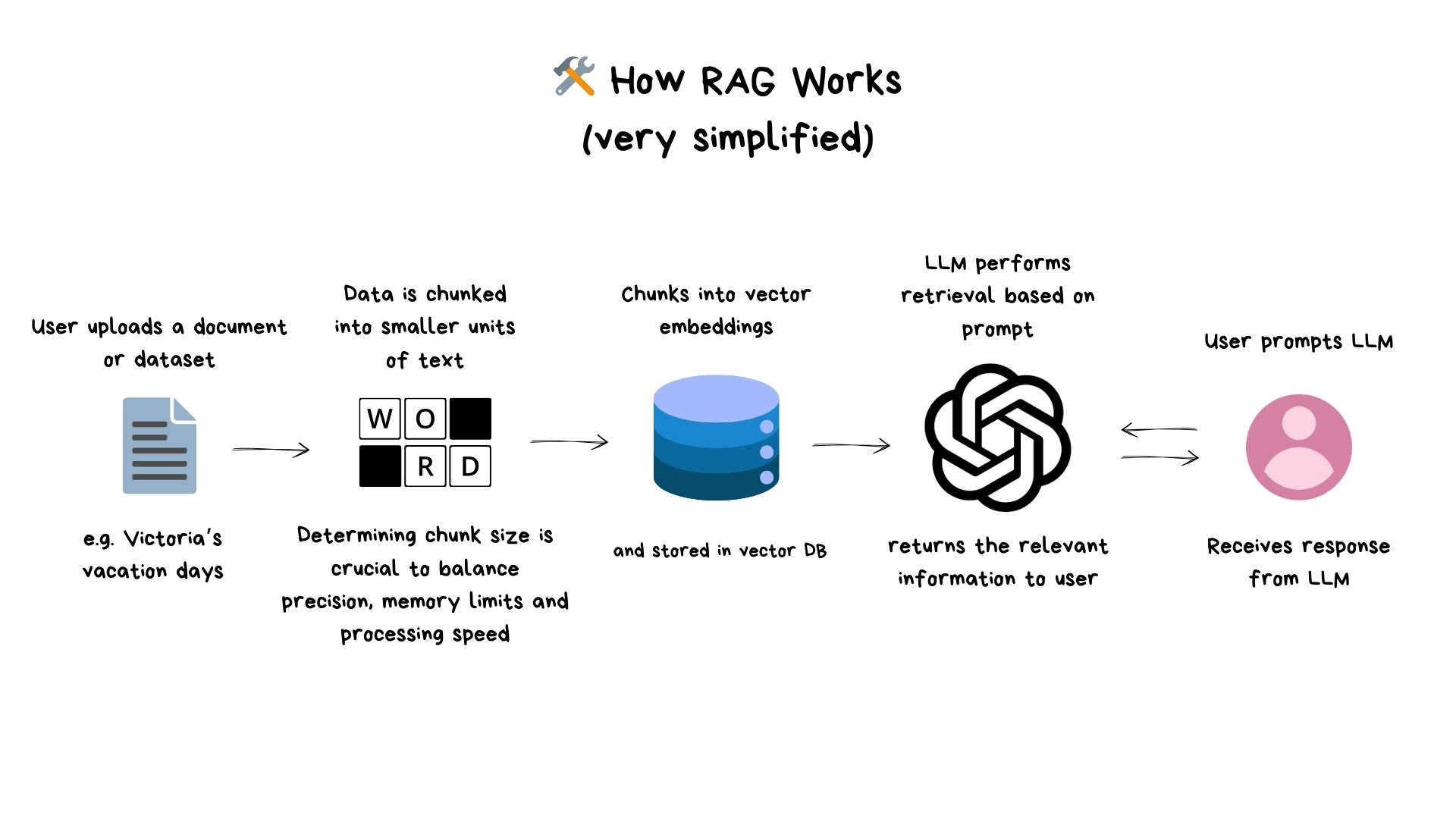
How RAG Works:
Chunking Data: Start with a document or dataset, like a PDF containing Victoria’s vacation days. The document is broken into chunks of text small enough to fit into the LLM’s memory, which can handle up to 100,000 tokens.
Embedding Creation: These chunks are converted into embeddings—vector representations that capture the semantic meaning of the text.
(This topic can go deeper into transformer models which is outside this article’s scope.)Vector Search: When you pose a question like, “How many days off did Victoria take in 2024?” the system performs a vector search from the vector database. If any chunk in the document contains relevant information (e.g., “days off” or “2024”), it finds the exact match.
Answer Generation: The relevant chunk is fed back into the LLM, which then generates a precise, context-aware answers.
So what does this all means? It means that RAG enables LLMs to answer questions with increased accuracy by accessing external, domain-specific knowledge. Businesses have developed RAG applications for practical uses, such as a chatbot that can answer customer or product-specific questions. In 2023, RAG has dominated and enhanced the usability and scalability of LLM-powered applications.
What if?
But now, what if I ask: Based on the number of vacation days Victoria has left in 2025, suggest an itinerary for a Europe trip.
In this case, I would need my chat application to be capable of searching not only my vacation days data, but also perform web search to provide a reasonable itinerary for an X-day Europe trip.
One of the fallbacks of the naive RAG system is that it only retrieves information from a specific knowledge source that we already define for it (i.e. Victoria’s vacation days data). This means that it does not have the agency to decide which knowledge source to get its information from, making it a challenge when designing a solution for complex use cases.
AI Agents as Reasoning Planners
Recognizing this challenge, more businesses began to adopt agentic frameworks in 2024. An agentic RAG implements AI agents into the workflow, which can go beyond answering questions. AI agents act as reasoning planners, capable of orchestrating multiple downstream tasks.
TLDR: AI agents are powered by LLMs to execute end-to-end tasks autonomously and make decisions in real time to achieve their given objectives.
The pillars that make up an AI agent are:
LLM (with a role and a task like a vacation days planner, etc.)
Memory (access to chat history, previous responses, etc.)
Planning (downstream tasks like routing, etc.)
Access to external tools to perform actions (web search, calendars, etc.)
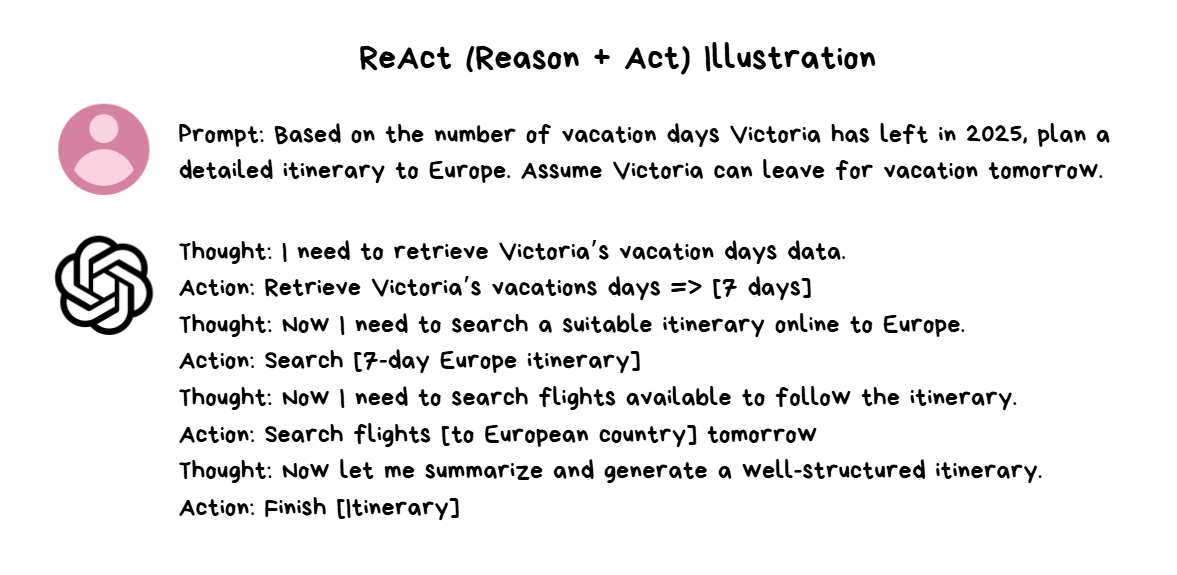
ReAct (not the front-end one) agent model, which stands for "Reasoning & Acting," is a framework that combines both reasoning and action in AI agents. These agents are not limited to providing answers based on pre-programmed knowledge; instead, they can strategically plan and execute complex sequences of tasks to achieve specific objectives.
For example, here are some practical applications for AI Agents:
Contract Negotiation: Imagine an AI agent designed to negotiate leases with landlords. The agent can analyze terms, suggest counteroffers, and even simulate negotiations.
Personal Virtual Assistants: Tools like Google’s Bard demonstrate the potential for AI agents to act as comprehensive personal assistants, handling tasks like scheduling meetings, generating summaries, or organizing events.
And the possibilities are endless! There are infinite ways to design agent-powered solutions, from simple single-agent to multi-agent solutions, from simple automation of daily tasks to complex task management. Let’s go back to our RAG example and learn how an Agentic RAG works.
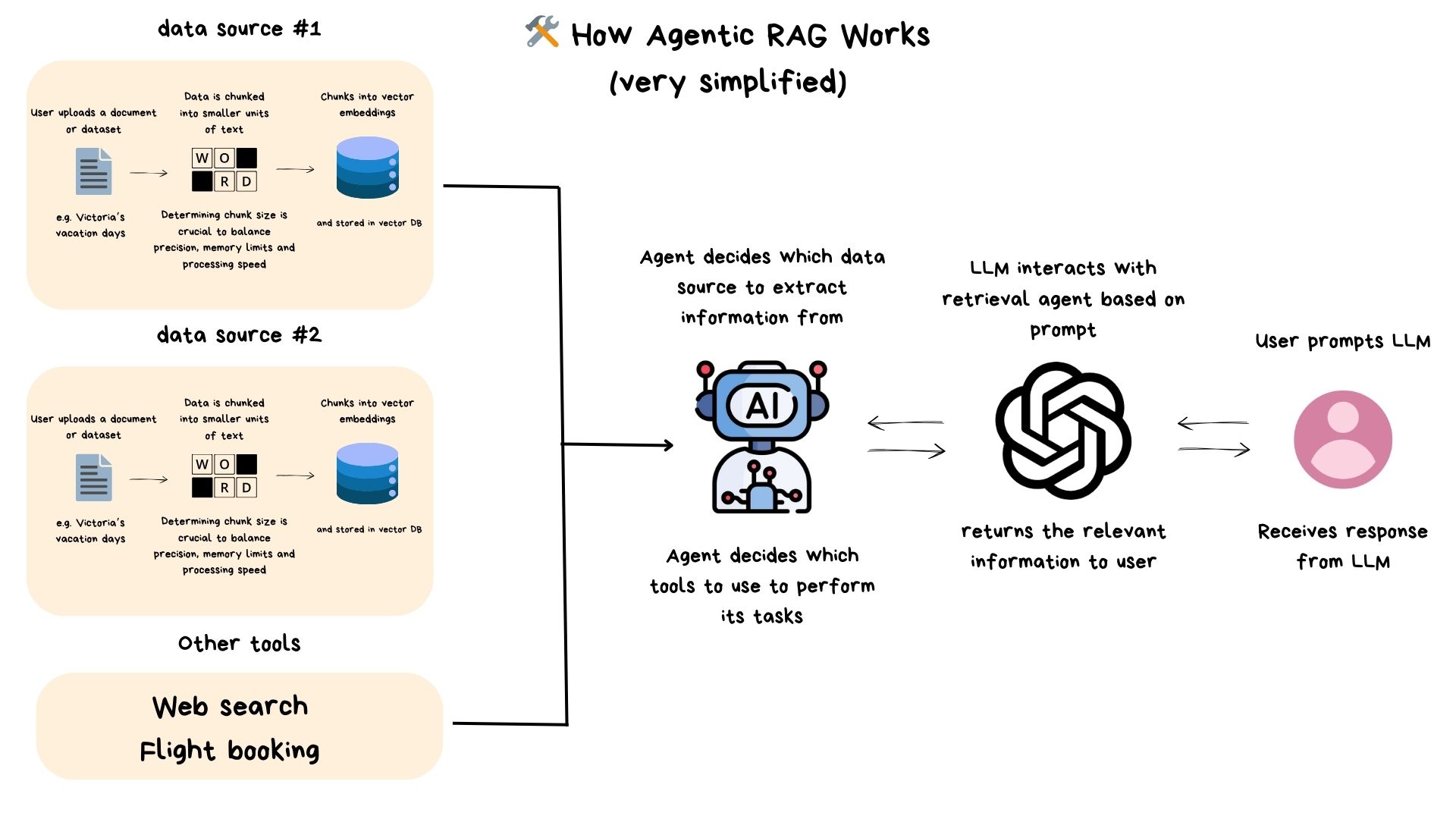
How Agentic RAG Works (very simplified):
Goal Identification: The user defines a task, like creating a travel itinerary or automating a business process.
Task Decomposition: The AI agent uses reasoning to break the goal into smaller tasks. Decide which knowledge source to retrieve the necessary information from.
Execution: Tasks are executed through a combination of LLM calls (to generate the content) and API calls (e.g. fetching weather data, searching popular itineraries, etc.).
Evaluation: The AI agent then decides whether the retrieved information is relevant and can choose to re-retrieve from other sources if needed.
Why You Should Care?
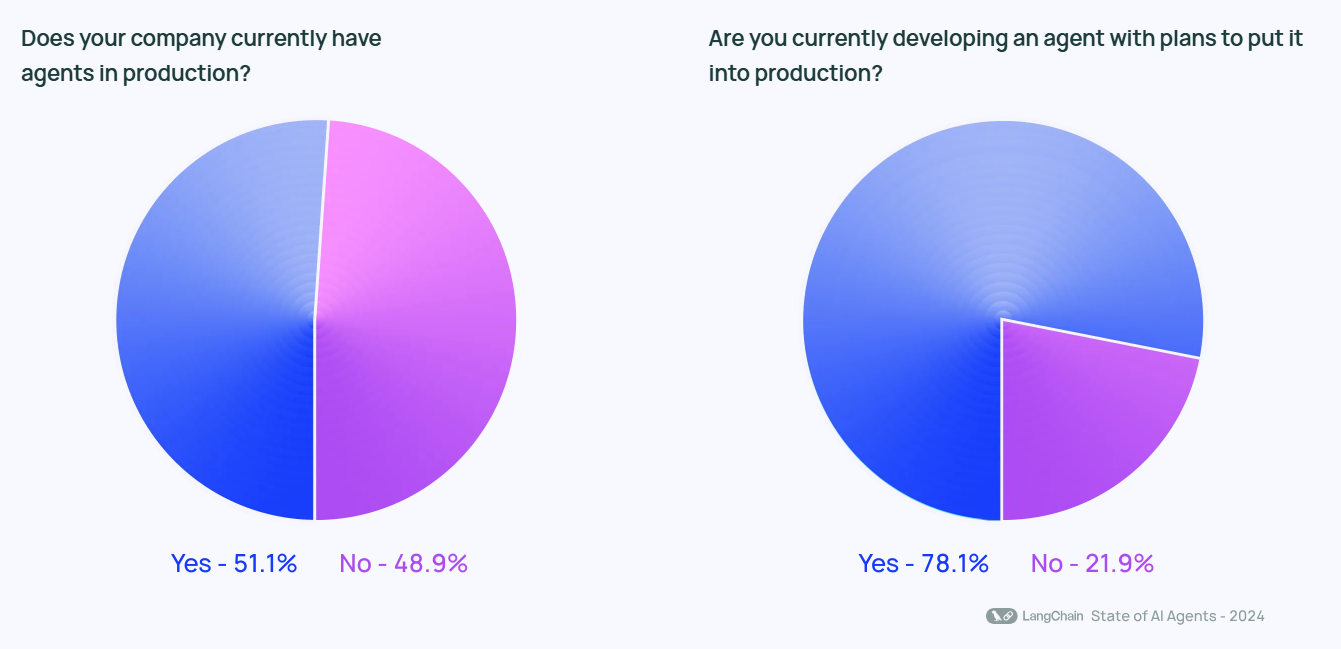
According to LangChain’s State of AI Agents report, about 78% of businesses are planning to implement AI agents in 2024. AI Agents are not just futuristic concepts—they’re here, and they’re transforming industries.
If you are a business owner or an innovator, here’s why you should pay attention:
Enhanced Productivity: AI agents can automate repetitive tasks, freeing up your time for more creative or strategic work.
Customizable Intelligence: With Agentic RAG, businesses can tailor AI solutions to their unique datasets, improving accuracy and reliability beyond the naive RAG solutions.
Competitive Advantage: Early adopters of AI agents can outpace competitors by leveraging data-driven insights and automating decision-making.
Tools to Build AI Agents and How to Get Started
AI Agents boomed in 2024 and now in 2025, we developers looking to create AI agents have access to a wide range of tools and frameworks. Here are 3 most popular options:
1. LangGraph
Probably the most popular framework for developing complex agentic workflows. It’s known to be highly customizable, and simplifies the creation of AI agents by providing tools for memory, chaining, and integration with APIs.
Will publish a step-by-step tutorial on this so stay tuned!
2. OpenAI Swarm
Developed by OpenAI, Swarm can be used to create reasoning agents that can handle text-based tasks. It’s known to be lightweight, “educational” and used to create smaller agents that are highly controllable and testable.
I’m still experimenting with this but also hope to build a demo to compare with LangGraph.
3) CrewAI
It’s one of the newer frameworks that is growing in popularity. It is simple to use because you can create agents with prompts, great for collaboration and developing multi-agent systems. However, it is known to be less versatile than LangGraph in terms of making highly complex workflows.
4) Postman AI Agent Builder
This news was just out at the time of writing this article, Postman just launched its AI Agent Builder tool to help with making AI Agents easier, faster and more reliable! I’m excited to check out this one too!
Link to the news article
Conclusion
As AI continues to evolve, the question isn’t whether you should use AI agents but how you can best integrate them into your personal or professional life. From streamlining operations to answering complex questions, AI agents are redefining how we work, learn, and innovate.
Thanks for reading! Hope this article has been helpful! If it has, do leave a like, share the article and comment your thoughts below! Have you developed AI agents? Stay tuned for more AI for everyone content! Cheers!
Let's Connect!
References
https://www.langchain.com/stateofaiagents
https://klu.ai/glossary/react-agent-model